EXHIBITION
FMCMP MADRID CENTRE
09 OCTOBER, 2024
19 JULY, 2026

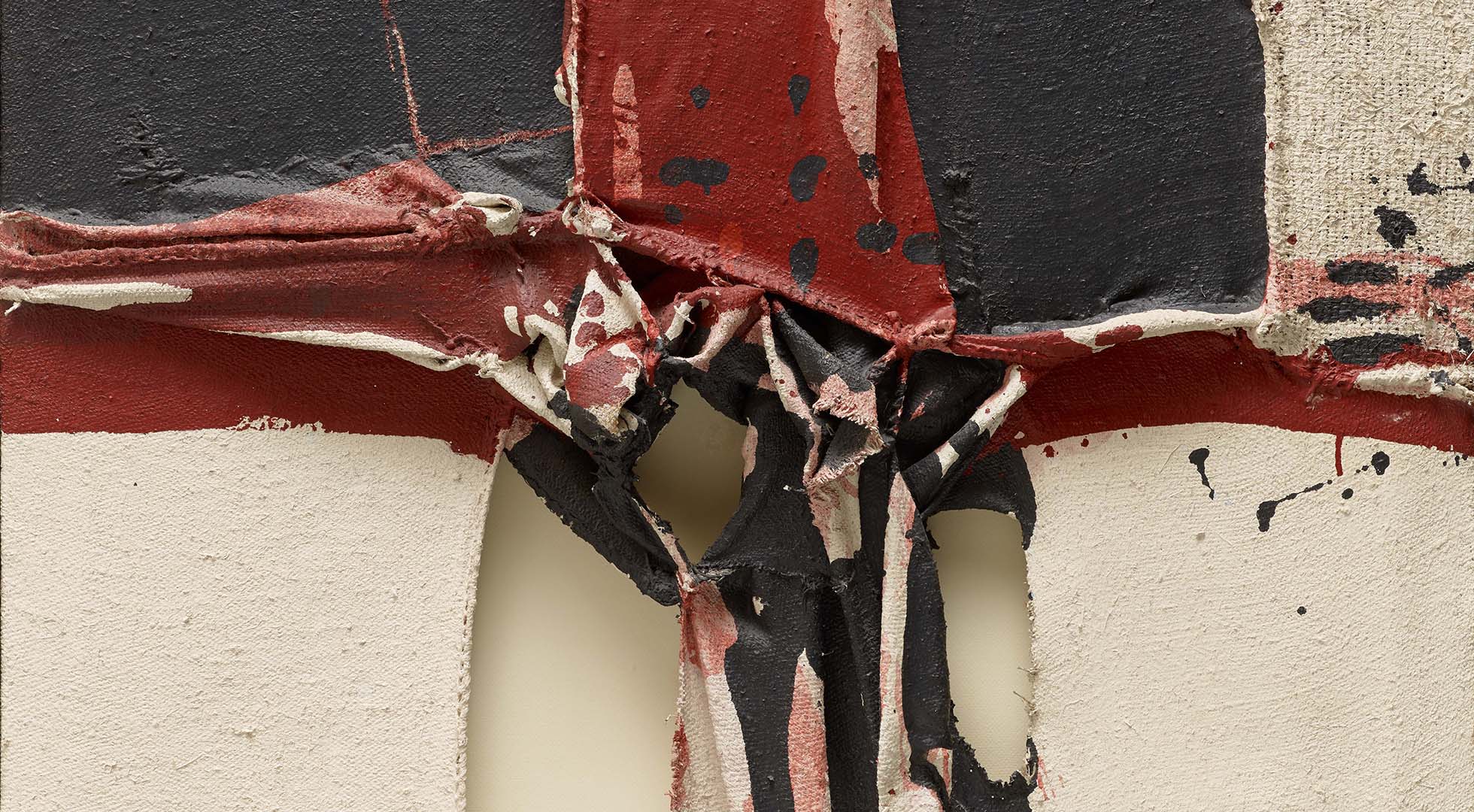
Cuadro 185 (1962) (Detail). Manuel Millares. Colección Masaveu ©Manolo Millares, VEGAP, Madrid, 2026 © de la reproducción: Fundación María Cristina Masaveu Peterson. Foto: Marcos Morilla

In connection with the exhibition Masaveu Collections. Textil Art, Fundación María Cristina Masaveu Peterson is pleased to present the latest instalment of Guest Works, a programme that periodically exhibits pieces by artists represented in the Masaveu collections in order to raise the profile of these holdings and shed new light on some of their most outstanding authors.
Although artists such as Joan Miró and Pablo Picasso had used fabrics in their collages in the 1920s, replacing representation with the material itself as a means of doing away with the illusionism of traditional painting, it was not until the 1950s that fabric gained prominence in Spain as a painting medium. Informel artists incorporated threads, ropes, stitching and fabrics into their works to break with the visual plane and respond to the hardship and gloom of the post-war period.
Manolo Millares started using hessian sacks in 1954. He gradually moved away from the Canarian pictograms that characterised his earlier work, toning down his colour palette to draw attention to the fabric – cut out, sewn, crumpled into amorphous shapes, and painted with simple planes or drips of basic colours. In doing so, he replaced the expressiveness of drawing with that of the material itself, creating vaguely anthropomorphic representations that recall Guanche mummies, as well as the laceration of a wounded era in need of stitching.
The use of unorthodox and hybrid materials in art during this period is also a feature of Manuel Rivera’s work. By 1956, he had completely abandoned the use of canvas in favour of commercially available or hand-made metal mesh. Experimenting with the different weaves and opening sizes of the meshes, he superimposed them to create shadows and transparencies. Initially, he grouped them together to form fragmented and haphazard shapes. Later, he employed them to construct taut geometric structures, making use of the frame to create a play of light and shadow by separating them from the wall.
In the 1960s, works by Millares and Rivera, related to the textile experiments of Josep Grau-Garriga and Aurèlia Muñoz, as well as pieces by Antoni Tàpies – another pioneer in the exploration of fabric – were exhibited at the MoMA in New York in shows dedicated to assemblage as a characteristic method of the period.
Susana Solano’s approach differs radically from that of the practitioners of Art Informel. In contrast, during the early years of the so-called New Spanish Sculpture movement, her textile experiments of 1979–80 employed folds and stitching to create three-dimensional forms from soft, flexible materials. The piece in this room uses the malleability of lead to transform the fold into a basic sculptural gesture. The title, Doblec No. 10, refers to this gesture, as well as to the work’s dual nature as both an abstract sculpture and a tea towel, to which the painted stripes allude.
FMCMP MADRID CENTRE
09 OCTOBER, 2024
19 JULY, 2026