IT MUST BE SEEN. THE AUTONOMY OF COLOUR IN ABSTRACT ART
Organised by: Fundación Juan March
Curator: Dª María Zozaya Álvarez, D. Manuel Fontán del Junco and Mr. Paul Smith
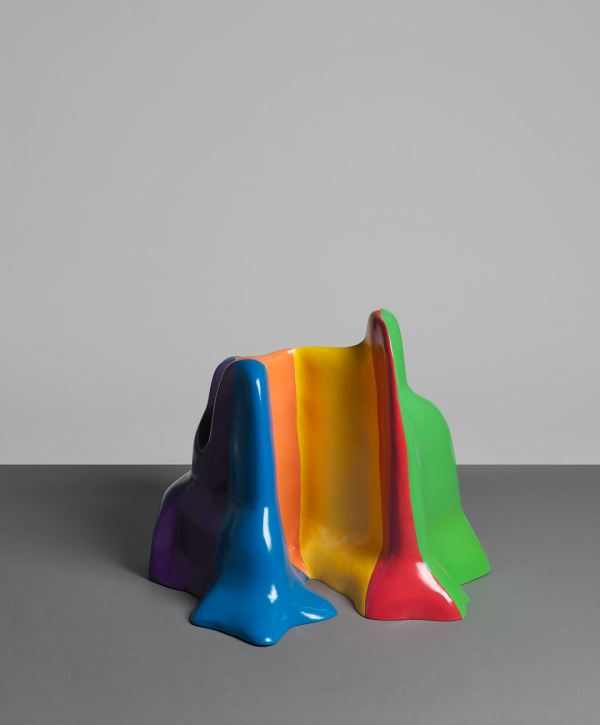
Works from the FMCMP Collection loaned for the exhibition: Small Splotch nº 3, 2001. Author: Sol Lewitt (Hartford, Connecticut, EEUU, 1928 – Nueva York, 2007. Owner: FMCMP Collection.
It Must Be Seen: The Autonomy of Colour in Abstract Art features the work of a wide number of artists from the twentieth and twenty-first centuries for whom colour is an essential structural element. The exhibition highlights the first experiments in abstraction, with a special focus on the use of flat colours, unmodulated by gesture. In addition to paintings, sculptures and works on paper, the show includes artists’ films and videos, installations and site-specific interventions, textiles, ceramics, photographs, books and documents. A separate part of the exhibition will be dedicated to the precursors of the autonomy of colour, with publications by eighteenth- and nineteenth-century theorists, diagrams and colour charts, pieces that showcase the sources of colour across different civilisations and their use throughout history. This section also features the first abstract experiments with colour, such as those of Wassily Kandinsky and Kazimir Malevich, which would lay the foundations for expanded colour field painting in the second half of the twentieth century and the early decades of the twenty-first century.
Considered a key artist of the minimalist movement, along with Carl Andre, Dan Flavin, Donald Judd and Robert Morris, Solomon LeWitt (better known as Sol LeWitt, Hartford, Connecticut, 1928–New York, 2007) was also a leading figure of post-minimalism and a founding father of conceptual art. In 1999 he started experimenting with new types of sculpture composed of wavy, eccentric contours in bright colours applied with shiny acrylic paint. Small Splotch #3 is a prime example.
Castelló 77
Madrid
28 February 2025 – 08 June 2025